

Annunciation of Mary

Introduction
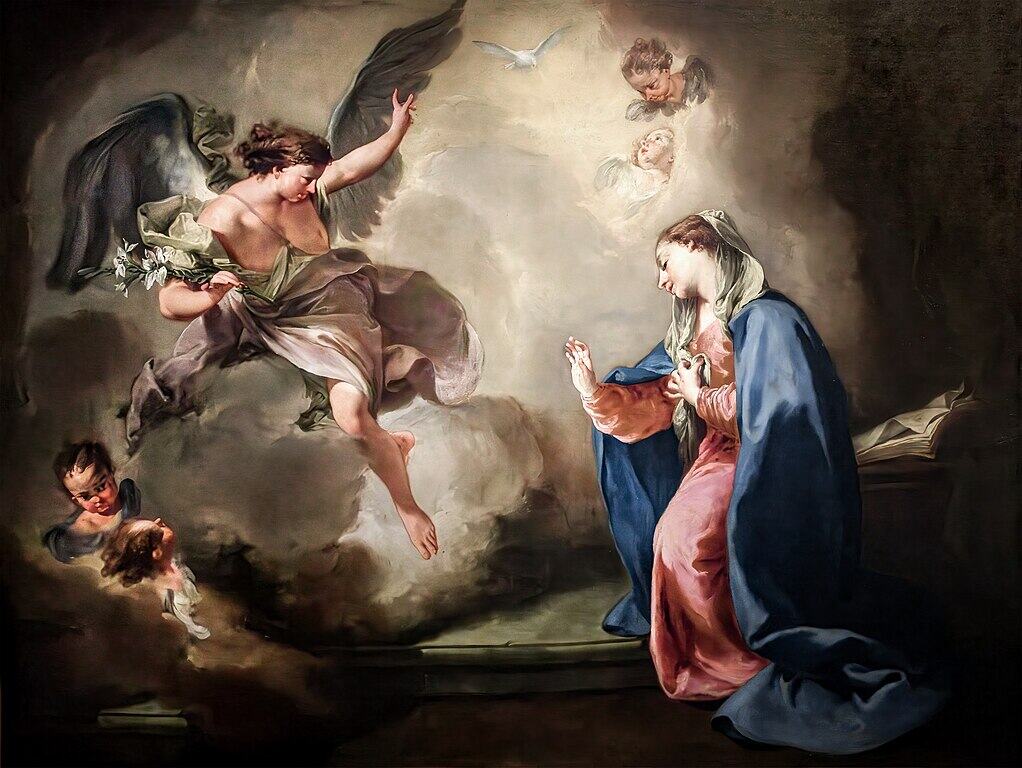
The Annunciation of Mary is the moment when the Angel Gabriel appeared to the Blessed Virgin Mary in Nazareth and announced that she had been chosen to conceive Jesus Christ, the Son of God, by the power of the Holy Ghost. Her humble and free acceptance of God’s will — her “fiat” — marks the beginning of the Incarnation, when the Word of God became flesh in her womb for the salvation of mankind. The word “Annunciation” comes from the Latin “annuntiatio”, meaning announcement, and refers specifically to this sacred exchange recorded in Luke 1:26–38.
The Annunciation of Mary is the First Joyful Mystery of the Rosary and one of the most pivotal moments in all of salvation history. It is celebrated by the Church each year on March 25 as the Solemnity of the Annunciation of the Lord. Gabriel greets Mary as “full of grace,” revealing her unique holiness and her singular role in God’s redemptive plan. Though she does not yet understand how this will be accomplished, she responds with complete faith and obedience:
“Behold the handmaid of the Lord; be it done to me according to thy word.” — Luke 1:38
This mystery is the first of the Joyful Mysteries of the Rosary, prayed as part of the Decade Mysteries of the Rosary. Catholics meditate on it to grow in humility, trust, purity of heart, and surrender to the will of God — virtues that Mary modeled in her quiet, hidden yes to heaven.
At What Event Did Mary Give Her Fiat?
Mary gave her fiat at the Annunciation of Mary — the moment recorded in Luke 1:26–38 when the Angel Gabriel appeared to her in Nazareth and announced that she would conceive Jesus Christ, the Son of God, by the power of the Holy Ghost. Her words, “Behold the handmaid of the Lord; be it done to me according to thy word” (Luke 1:38), mark the precise instant when the Word became flesh in her womb. This event is the First Joyful Mystery of the Rosary and the beginning of the Incarnation.
Scripture of the Annunciation
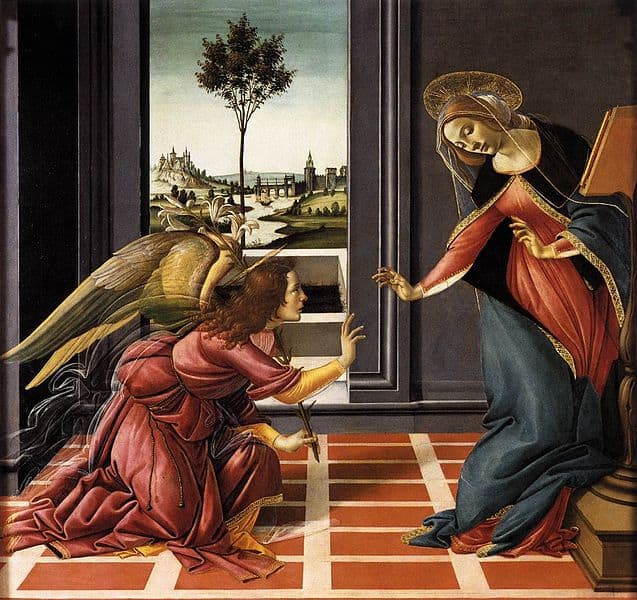
And in the sixth month, the angel Gabriel was sent from God into a city of Galilee, called Nazareth, to a virgin espoused to a man whose name was Joseph, of the house of David; and the virgin’s name was Mary. And the angel being come in, said unto her: Hail, full of grace, the Lord is with thee: blessed art thou among women. Who having heard, was troubled at his saying, and thought with herself what manner of salutation this should be.
And the angel said to her, Fear not, Mary, for thou hast found grace with God. Behold thou shalt conceive in thy womb, and shalt bring forth a son, and thou shalt call his name Jesus. He shall be great and shall be called the Son of the most-High; and the Lord God shall give unto him the throne of David his father; and he shall reign in the house of Jacob forever. And of his kingdom there shall be no end.
And Mary said to the angel “How shall this be done because I know not man?” And the angel answering, said to her: The Holy Ghost shall come upon thee, and the power of the most-High shall overshadow thee. And therefore also the Holy which shall be born of thee shall be called the Son of God. And behold thy cousin Elizabeth, she also hath conceived a son in her old age; and this is the sixth month with her that is called barren: Because no word shall be impossible with God.
And Mary said: Behold the handmaid of the Lord; be it done to me according to thy word. And the angel departed from her. (Luke 1:26-38)
Additional Scripture
These passages shed light on the Annunciation and the mystery of the Incarnation:
- The birth of Jesus announced to Joseph (Mt 1:18–25, Douay-Rheims)
- “The Word was made flesh, and dwelt among us” (Jn 1:14, Douay-Rheims)
- “God sent his Son, made of a woman” (Gal 4:4–5, Douay-Rheims)
- The first promise of a Redeemer (Gn 3:15, Douay-Rheims)
- The Emmanuel prophecy: “a virgin shall conceive” (Is 7:14, Douay-Rheims)
- God’s promise of an everlasting kingdom to David (2 Ki 7:12–16, Douay-Rheims)
> You may also wish to link to Catechism paragraphs that treat the Annunciation and the Incarnation (for example, CCC 456–460, 484–494, 2617–2619).
Walking Through the Annunciation of Mary Step by Step
The Setting: Nazareth and the Virgin of David’s House
The scene begins in Nazareth, a place of no importance in the eyes of many. Mary lives a hidden life there, betrothed to Joseph, a just man of the house of David. There is no palace, no crowd, only a quiet home. Into this silence God sends Gabriel. This shows how God loves to work in what seems small and unnoticed.
Gabriel’s Greeting and Message
Gabriel enters and speaks words never before addressed to any human being: “Hail, full of grace, the Lord is with thee” (Luke 1:28). He does not call her by name at first. He calls her by what God has done in her soul. Mary has received a singular grace in view of her task as Mother of the Savior.
The angel then announces a child: she will conceive and give birth to a son who will be named Jesus. He will be great, the Son of the most High, heir to the throne of David, and His reign will have no end (Luke 1:31–33). This is not only a birth announcement but a royal proclamation.
Mary’s Question and Gabriel’s Answer
Mary’s question, “How shall this be done, because I know not man?” (Luke 1:34), is not disbelief. She believes the promise but wants to understand how it will be fulfilled while she remains a virgin. Gabriel answers with one of the holiest lines of Scripture: “The Holy Ghost shall come upon thee, and the power of the most High shall overshadow thee” (Luke 1:35). This shows that the conception of Jesus is entirely the work of the Holy Ghost.
Gabriel then gives a sign: Elizabeth, once called barren, is now in her sixth month, because “no word shall be impossible with God” (Luke 1:37). Mary is invited to trust.
Mary’s Fiat and the Moment of the Incarnation
After hearing God’s plan, Mary gives her answer:
“Behold the handmaid of the Lord; be it done to me according to thy word” (Luke 1:38).
At this instant, by the power of the Holy Ghost, the eternal Son of God takes flesh in her womb. This is the Incarnation—God the Son assuming a true human nature. The Catechism teaches that “the Word became flesh by the power of the Holy Spirit in the womb of the Virgin Mary, at the moment of the Annunciation” (CCC 484). This is not a symbol but a real event in time.
The Fruit of the Mystery: Humility and Obedience of Faith
The traditional fruit of this mystery is humility and obedience of faith. Mary calls herself the handmaid of the Lord and freely places her entire life into God’s hands. She does not know how Joseph will respond, what suffering may come, or how God’s plan will unfold. Yet she trusts completely. In the Annunciation, a person learns that holiness begins with surrender. True greatness is found in saying yes to God even when the path ahead cannot yet be seen.
Doctrinal and Spiritual Meaning of the Annunciation
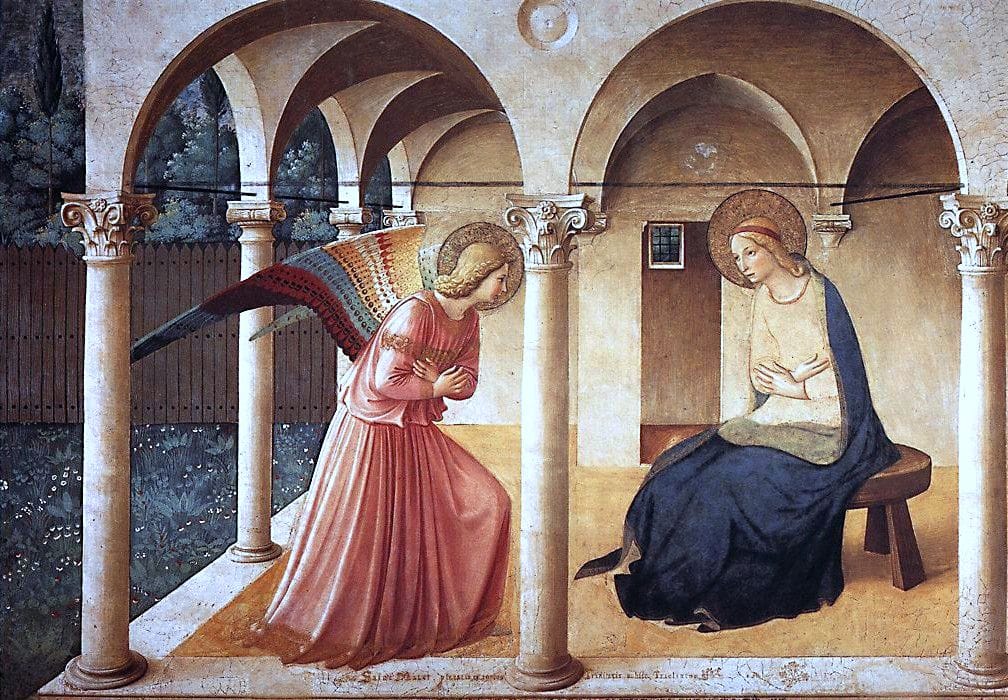
What the Annunciation Reveals About Jesus
The Annunciation shows that Jesus is true God and true man from the first moment of His human life. Gabriel calls Him “the Son of the most High” and speaks of His everlasting reign (Luke 1:32–33). At the same time, he announces a real conception, a real birth, in a real womb.
The Catechism teaches that the Son of God is made man so that He may save us by reconciling us with the Father, reveal the Father’s love, and be our model of holiness (CCC 457–459). All of this begins here, in Mary’s yes.
What the Annunciation Reveals About Mary
Mary is greeted as “full of grace” (Luke 1:28). This points to the mystery of her Immaculate Conception and her unique preparation for this mission. God chose her from all eternity to be the Mother of His Son.
At the Council of Ephesus (431), the Church solemnly confessed that Mary is Theotokos, God-bearer or Mother of God, because the child she carries is a divine Person. This protects the truth about Jesus: He is one Person, the eternal Son, with both a human nature and a divine nature. To deny Mary as Mother of God is to tear the mystery of Christ Himself.
Mary’s yes is free. God does not force her; He asks. The Catechism says that “Mary’s consent… was given on behalf of all human nature” and that by her obedience, she became the new Eve, the mother of all the living in grace (CCC 488, 494).
The Annunciation also reveals Mary as the New Eve. Where Eve listened to the fallen angel and brought disobedience into the world, Mary listens to the angel Gabriel and responds with faith. Through her obedience, God begins the work of redemption through Jesus Christ, the New Adam.
Key Teachings from the Catechism
A few lines from the Catechism help a person see the heart of this mystery:
- The Son of God assumed a human nature in Mary’s womb by the power of the Holy Ghost (CCC 484–485).
- Mary’s free cooperation is part of God’s loving plan (CCC 488, 494).
- Because her Son is divine, Mary is rightly called Mother of God (CCC 495).
These are not cold formulas. They are windows into the love of God who comes near through a woman’s faith.
The Council of Ephesus (431) and Theotokos
The Council of Ephesus confirmed what this mystery already shows: the child in Mary’s womb is God the Son. Calling Mary Theotokos protects the faith in Christ’s true divinity and true humanity. When a person prays the Annunciation, they stand with the Church in confessing that the One conceived in Mary is God made man.
Old Testament Prophecies and Foreshadowings Fulfilled
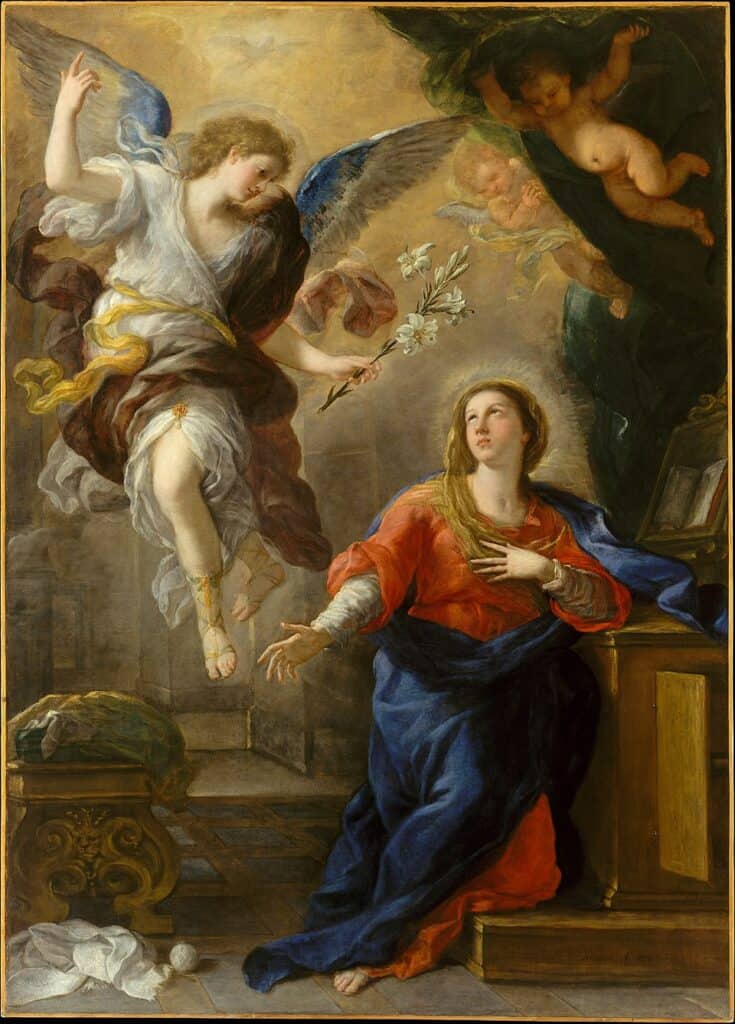
Isaiah 7:14 – The Virgin Shall Conceive
The prophet Isaiah foretold: “Behold a virgin shall conceive, and bear a son, and his name shall be called Emmanuel” (Isaiah 7:14). At the Annunciation, this promise is fulfilled in Mary. She is the Virgin who conceives and bears the Child who is truly Emmanuel—God with us. When Gabriel speaks to her, the long expectation of Israel quietly comes to its fulfillment.
Genesis 3:15 – The Woman and Her Seed
In Genesis 3:15, often called the Protoevangelium, God speaks to the serpent: “I will put enmity between thee and the woman, and thy seed and her seed; she shall crush thy head.” In Mary, this Woman stands before us. Her seed is Christ, who will conquer sin and death through His Passion and Resurrection. At the Annunciation, this saving plan begins to be carried out in a visible way.
2 Samuel 7:12–13 – The Davidic King
God promised King David that his throne would be established forever (2 Samuel 7:12–13). Gabriel echoes this when he says that the child to be born will receive “the throne of David his father” and that His reign will have no end (Luke 1:32–33). Jesus is not only a teacher or a prophet; He is the promised King, the Son of David whose kingdom has no sunset.
The Annunciation in the Life of the Church
Feast Day: March 25
The Solemnity of the Annunciation of the Lord is celebrated on March 25, nine months before Christmas. On this day, the Church gives thanks for the Incarnation and honors the obedience of the Blessed Virgin Mary. The Mass prayers speak of the Word taking flesh and of Mary’s free consent. In many places, this feast is marked by special devotions, consecrations to Jesus through Mary, and the solemn praying of the Angelus.
The Angelus is a short prayer prayed three times daily — morning, noon, and evening — that directly commemorates the Annunciation of Mary. It begins with the words, “The Angel of the Lord declared unto Mary: and she conceived by the Holy Ghost,” and ends with the Hail Mary. Daily recitation of the Angelus is one of the most practical ways a Catholic can keep the memory of this mystery alive throughout the year.
If March 25 falls during Holy Week or the Octave of Easter, the feast is transferred to the Monday following the Second Sunday of Easter — a sign of how important this solemnity is in the Church’s calendar.
The Annunciation in the Liturgy and the Creed
Every Sunday and solemnity, when the Creed is prayed, the Church recalls the Annunciation in the line: “And was incarnate by the Holy Ghost of the Virgin Mary, and was made man.” Many faithful bow or kneel at these words. This habit is a small echo of Mary’s own adoration at the moment when God’s Son began His hidden life in her.
The Preface and prayers of the Mass on March 25 invite the faithful to give thanks that through Mary’s yes, salvation has drawn near.
The Angelus: Praying the Annunciation
of Mary Three Times a Day
The Angelus is a short prayer founded in the Annunciation of Mary, traditionally prayed three times daily at morning, noon, and evening — often at the sound of a bell. It takes its name from its opening words in Latin: “Angelus Domini nuntiavit Mariae” — “The Angel of the Lord declared unto Mary.” The prayer recounts the Angel’s message, Mary’s response, and the Incarnation, and concludes with the Hail Mary prayed three times.
For centuries, the Angelus has been the daily rhythm by which Catholics have kept the memory of the Annunciation alive in the midst of ordinary life. Praying it at noon — the traditional midday pause — connects a person to the mystery of the Incarnation at the center of each day.
Praying the Annunciation as a Decade of the Rosary
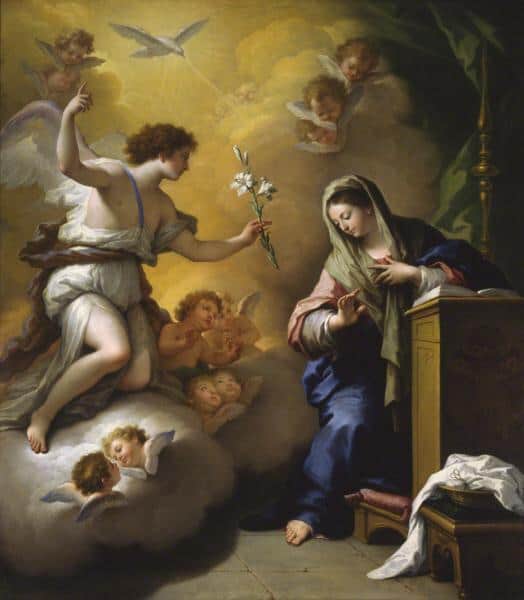
Calling the Mystery to Mind Before the Decade
Before beginning the Our Father for this decade, it helps to pause for a few seconds and picture the scene: Mary at prayer or at work in her home, Gabriel entering with light, the greeting, the holy silence before her answer. A person can simply say in their heart, “Lord, help me to stand with Mary and listen.”
Meditating on The Annunciation as a Decade of the Rosary
During this decade of the Rosary, a person should place himself spiritually within the mystery of the Annunciation of Mary. One can imagine the silence of Nazareth: Mary at prayer, Gabriel entering with light, the holy pause before her answer, and the moment her fiat changes the course of human history. Each Hail Mary in this decade becomes a prayer for the grace to say yes to God with the same humility and courage that Mary showed. Those who wish to pray the full Joyful Mysteries may find the printable Joyful Mysteries PDF helpful for private or family prayer.
Living the Mystery of the Annunciation in Daily Life
Learning to Say “Fiat” in Ordinary Duties
Mary’s fiat was given in a quiet home, not on a stage. Most Catholics will never be asked to do great deeds in public, but they are asked, day after day, to be faithful in small things. One can whisper, “Be it done to me according to Thy word,” before starting a hard task, caring for a sick family member, or facing a difficult conversation. In this way, the Annunciation stretches through each day.
Trusting God When the Future Is Unclear
Mary did not receive every answer before giving her yes to God. She accepted His will before knowing how events would unfold. Many people hesitate because they want certainty, control, or visible proof. The Annunciation teaches a different path: trust first, then walk forward in faith. God often leads one step at a time. Like Mary, a person learns to say yes even when the future cannot yet be fully seen.
Welcoming Christ into One’s Heart and Home
As Mary welcomed Christ in her body, a person is invited to welcome Him in faith, especially in the sacraments. Each worthy Communion is a kind of little Annunciation, where the Lord comes to dwell in the soul. Families can honor this mystery by praying the Angelus, by placing a picture of the Annunciation in the home, and by inviting Jesus truly to be served and loved in their house.
Conclusion
The Annunciation of Mary is far more than a historical event. It is the beginning of the Incarnation and the moment God enters the world through the obedience of the Blessed Virgin Mary. In her fiat, Catholics see the model of perfect faith: humble, trusting, and completely open to the will of God. Every time this mystery is prayed in the Rosary, the faithful are invited to imitate Mary’s yes and welcome Jesus Christ more deeply into their own hearts. To continue meditating on the Joyful Mysteries, visit the Joyful Mysteries of the Rosary.
Frequently Asked Questions
Mary gave her fiat at the Annunciation, when the angel Gabriel announced that she would conceive Jesus Christ through the power of the Holy Ghost. Her response, “Be it done to me according to thy word,” marks the beginning of the Incarnation.
In the Rosary, the Annunciation is the First Joyful Mystery. A person meditates on Gabriel’s visit to Mary, her question, and her fiat. It is the moment when the eternal Son of God takes flesh in her womb by the power of the Holy Ghost. This decade teaches humility, listening, and trust.
The Annunciation is found in Luke 1:26–38. In this passage, Gabriel greets Mary with the words, “Hail, full of grace, the Lord is with thee,” and announces that she will bear a son, Jesus, who will reign forever. Mary asks how this can be, and Gabriel explains that the Holy Spirit will come upon her.
The Annunciation fulfills several key prophecies. Isaiah speaks of a virgin who will conceive Emmanuel (Isaiah 7:14). Genesis 3:15 promises a Woman and her seed who will crush the serpent’s head. God’s promise to David of an everlasting kingdom (2 Samuel 7:12–13) is taken up in Gabriel’s words about the throne of David and the endless reign of Christ. All of this quietly comes together in Mary’s yes.
The traditional fruit is humility and obedience of faith. Mary shows this by calling herself the handmaid of the Lord and by accepting His plan without knowing every detail. Those who pray this decade ask for the grace to set aside pride, avoid self-will, and say yes to God in daily life.
It is best to keep it simple: tell the story in plain language. Explain that God sent His angel to Mary, that He asked her to be the Mother of Jesus, and that she said yes. Show them a picture of the Annunciation, read a few verses from Luke 1, and invite them to pray one decade of the Rosary, asking Mary to help them trust God.
Many people struggle at first. It helps to choose one simple image—a small house at Nazareth, Mary listening, Gabriel speaking—and return to that whenever the mind wanders. A person can also ask Mary directly: “Mother, help me to pray this decade with you.” The important thing is not to give up; faithful prayer bears fruit over time.
When praying the Annunciation, a person should ask for the grace to trust God more deeply. Mary’s fiat was spoken in humility, faith, and surrender. This mystery reminds the faithful that God often works quietly through hidden obedience and simple acts of trust. Every soul is invited to echo Mary’s words: “Be it done to me according to thy word.”
Links
Decade Mysteries
- Annunciation of Mary (You are Here)
- Visitation of Mary
- Birth and Nativity of Jesus
- Presentation of Jesus at the Temple
- Finding Jesus in the Temple
- Agony in the Garden
- Scourging at the Pillar
- Crowning with Thorns
- Carrying of the Cross
- Crucifixion of Christ
- Resurrection of Jesus
- Ascension of Jesus
- Pentecost
- Assumption of Mary
- Coronation of Mary
- Baptism of Jesus
- Wedding at Cana
- Proclamation of the Kingdom
- Transfiguration of Jesus
- The Eucharist

Charles Rogers is a resident of South Carolina and a retired computer programmer by trade. Raised in various Christian denominations, he came to faith in Jesus Christ early in life. In 2012, he began experiencing authentic spiritual encounters with the Blessed Virgin Mary, which led him on a seven-year journey at her hands, that included alcohol addiction, a widow maker heart attack and death and conversion to the Catholic Faith. He is the exclusive author and owner of Two Percent Survival, a website dedicated to and created in honor of the Holy Mother. Feel free to email Charles at twopercentsurvival@gmail.com.

May Our Lady of the Rosary lead you deeper into the grace you have been given. Pray always, and trust the mercy of God while the door remains open.
— Two Percent Survival