

Rosary Schedule - Rosary Mysteries by Day
The Rosary schedule allows those who pray the Rosary to know which mysteries of the Rosary are prayed on each day of the week. There are two schedules commonly used today. The first, traditionally associated with the Blessed Virgin Mary and dating back to 1214, has been used by Catholics for centuries, while the other includes the Luminous Mysteries introduced by Pope John Paul II in 2002 through Rosarium Virginis Mariae. This guide explains both Rosary schedules, the history behind them, and how Catholics today continue to pray the daily Rosary mysteries as a meditation on the life, Passion, and glory of Jesus Christ.
A History of the Two Rosary Schedules
The Rosary schedule allows those who pray the Rosary to know which mysteries of the Rosary are prayed on each day of the week. There are two schedules commonly used today. The first, traditionally associated with the Blessed Virgin Mary and dating back to 1214, has been used by Catholics for centuries, while the other includes the Luminous Mysteries introduced by Pope John Paul II in 2002 through Rosarium Virginis Mariae. This guide explains both Rosary schedules, the history behind them, and how Catholics today continue to pray the daily Rosary mysteries as a meditation on the life, Passion, and glory of Jesus Christ.
Virgin Mary Gives the Original Mysteries in 1214
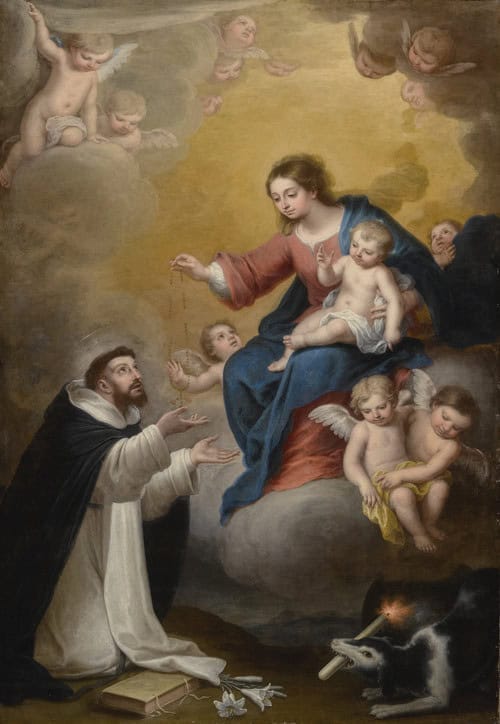
According to St. Louis de Montfort’s “The Secret of the Rosary“, the Blessed Virgin Mary
appeared to Saint Dominic in 1214 during a time of great struggle within the Church. Saint Dominic had been praying and preaching against the Albigensian heresy in southern France, where many people had fallen away from the Catholic Faith. In his suffering and discouragement, he turned to God in prayer and sought help from the Blessed Mother. Tradition holds that the Virgin Mary gave the Rosary to Saint Dominic as a spiritual weapon to combat heresy, bring about the conversion of souls, and rekindle the Catholic Faith.
The Virgin Mary later spoke of the greatness of the Rosary to Alanus de Rupe, also known as Blessed Alan de la Roche, saying: “When you say the Rosary the angels rejoice, the Blessed Trinity delights in it, my Son finds joy in it too, and I myself am happier than you can possibly guess. After the Holy Sacrifice of the Mass, there is nothing in the Church that I love as much as the Rosary.” For centuries, Catholics throughout the world have prayed the traditional fifteen mysteries of the Rosary, divided into the Joyful, Sorrowful, and Glorious Mysteries. These mysteries formed the original Rosary schedule used throughout the Church long before the Luminous Mysteries were later introduced in 2002.
Often called the world’s most popular prayer, the Rosary has been prayed by Catholics for nearly eight centuries as both a vocal and mental prayer. While the prayers are recited using Rosary beads, the mind meditates on the life, Passion, death, and glory of Jesus Christ. Pope Pius XII described the Rosary as “A synthesis of the whole Gospel: meditation on the mysteries of the Lord, an evening sacrifice, a garland of roses, a hymn of praise, a family prayer, a compendium of Christian life, a sure pledge of heavenly favors, a defense while we await our expected salvation.”
Pope John Paul II and the Luminous Mysteries in 2002

In 2002, Pope John Paul II introduced a new set of Rosary mysteries known as the Luminous Mysteries, or the Mysteries of Light, through his apostolic letter Rosarium Virginis Mariae. These mysteries focus on important events from the public ministry of Jesus Christ and were added to help Catholics meditate more deeply on His earthly mission between His hidden life and His Passion. The five Luminous Mysteries are the Baptism of Jesus in the Jordan, the Wedding at Cana, the Proclamation of the Kingdom of God, the Transfiguration, and the Institution of the Holy Eucharist.
Before 2002, Catholics had traditionally prayed the fifteen mysteries of the Rosary for centuries. Pope John Paul II explained that the addition of the Luminous Mysteries was not meant to replace the traditional Rosary but to enrich it by filling what he described as a gap between the Joyful and Sorrowful Mysteries. He encouraged the faithful to meditate on these moments of Christ’s public ministry as revelations of His divine light to the world.
With the addition of the Luminous Mysteries, a second Rosary schedule gradually became widely used throughout the Catholic Church. In this newer schedule, the Luminous Mysteries are prayed on Thursday, while the remaining mysteries continue on their traditional days. Even so, many Catholics still follow the older schedule of the traditional fifteen mysteries, which remains a respected and cherished devotion within the Church today.
Rosary Schedule
Including the Luminous Mysteries
- Monday — Joyful Mysteries
- Tuesday — Sorrowful Mysteries
- Wednesday — Glorious Mysteries
- Thursday — Luminous Mysteries
- Friday — Sorrowful Mysteries
- Saturday — Joyful Mysteries
- Sunday — Glorious Mysteries
Excluding the Luminous Mysteries
- Monday — Joyful Mysteries
- Tuesday — Sorrowful Mysteries
- Wednesday — Glorious Mysteries
- Thursday — Joyful Mysteries
- Friday — Sorrowful Mysteries
- Saturday — Glorious Mysteries
- Sunday — Glorious Mysteries during Ordinary Time and Easter; Sorrowful Mysteries during Lent; Joyful Mysteries during Advent and the Christmas season
Conclusion
The Rosary schedule has guided Catholics in meditation and prayer for centuries by assigning specific mysteries to each day of the week. While two schedules are commonly used today, both lead the faithful toward deeper meditation on the life, Passion, death, and glory of Jesus Christ through the intercession of the Blessed Virgin Mary. Some Catholics continue to pray the traditional fifteen mysteries long associated with Saint Dominic. In contrast, others follow the newer schedule that includes the Luminous Mysteries introduced by Pope John Paul II in Rosarium Virginis Mariae. No matter which schedule is used, the Rosary remains one of the most powerful and beloved devotions in the Catholic Church, drawing souls closer to Jesus Christ through prayer, reflection, and the loving guidance of His Blessed Mother.
Frequently Asked Questions
The Joyful Mysteries are traditionally prayed on Monday. These mysteries focus on the early life of Jesus Christ and include the Annunciation, the Visitation, the Nativity, the Presentation in the Temple, and the Finding of Jesus in the Temple.
The Sorrowful Mysteries are prayed on Tuesday. These mysteries meditate on the suffering and Passion of Jesus Christ, beginning with the Agony in the Garden and ending with the Crucifixion.
The Glorious Mysteries are prayed on Wednesday. These mysteries focus on the Resurrection of Jesus, His Ascension into Heaven, Pentecost, the Assumption of the Blessed Virgin Mary, and the Coronation of Mary as Queen of Heaven.
In the schedule introduced by Pope John Paul II in 2002, the Luminous Mysteries are prayed on Thursday. In the traditional Rosary schedule used before 2002, the Joyful Mysteries were prayed on Thursday.
The Joyful Mysteries are prayed on Saturday in the schedule that includes the Luminous Mysteries. In the traditional Rosary schedule, the Glorious Mysteries were commonly prayed on Saturday.
The Glorious Mysteries are usually prayed on Sunday. In the traditional Rosary schedule, however, the mysteries prayed on Sunday can change according to the Church calendar. The Glorious Mysteries are prayed during Ordinary Time and Easter, the Sorrowful Mysteries during Lent, and the Joyful Mysteries during Advent and the Christmas season.
The Luminous Mysteries, also called the Mysteries of Light, were introduced by Pope John Paul II in 2002 through Rosarium Virginis Mariae. They focus on the public ministry of Jesus Christ and include the Baptism of Jesus, the Wedding at Cana, the Proclamation of the Kingdom, the Transfiguration, and the Institution of the Holy Eucharist.
No. The Rosary is a private devotion, and Catholics are free to pray either the traditional fifteen mysteries or the newer schedule that includes the Luminous Mysteries.
According to Catholic tradition, the Blessed Virgin Mary gave the Rosary to Saint Dominic in 1214 as a spiritual weapon against heresy and for the conversion of souls.
The Rosary is one of the most beloved devotions in the Catholic Church because it leads Catholics to meditate on the life, Passion, death, and glory of Jesus Christ through prayer with the Blessed Virgin Mary. Catholics have prayed it throughout the world for centuries.

We strive to provide the most complete and highest quality material we can for you, our readers. Although not perfect, it is our desire and prayer that you benefit from our efforts.